Five Keys

Tour de Five Keys

Introducing Heather Calomese Our New President

Every great tour starts with a prologue, a short, revealing stage that sets the tone for the miles ahead. Since joining Five Keys in June, Heather Calomese has spent her first month exactly that way: listening, learning, and building relationships across every corner of the organization before setting her pace. From special education teacher to public policy, Heather brings her career in the classroom and education leadership to her new role as President of Five Keys.
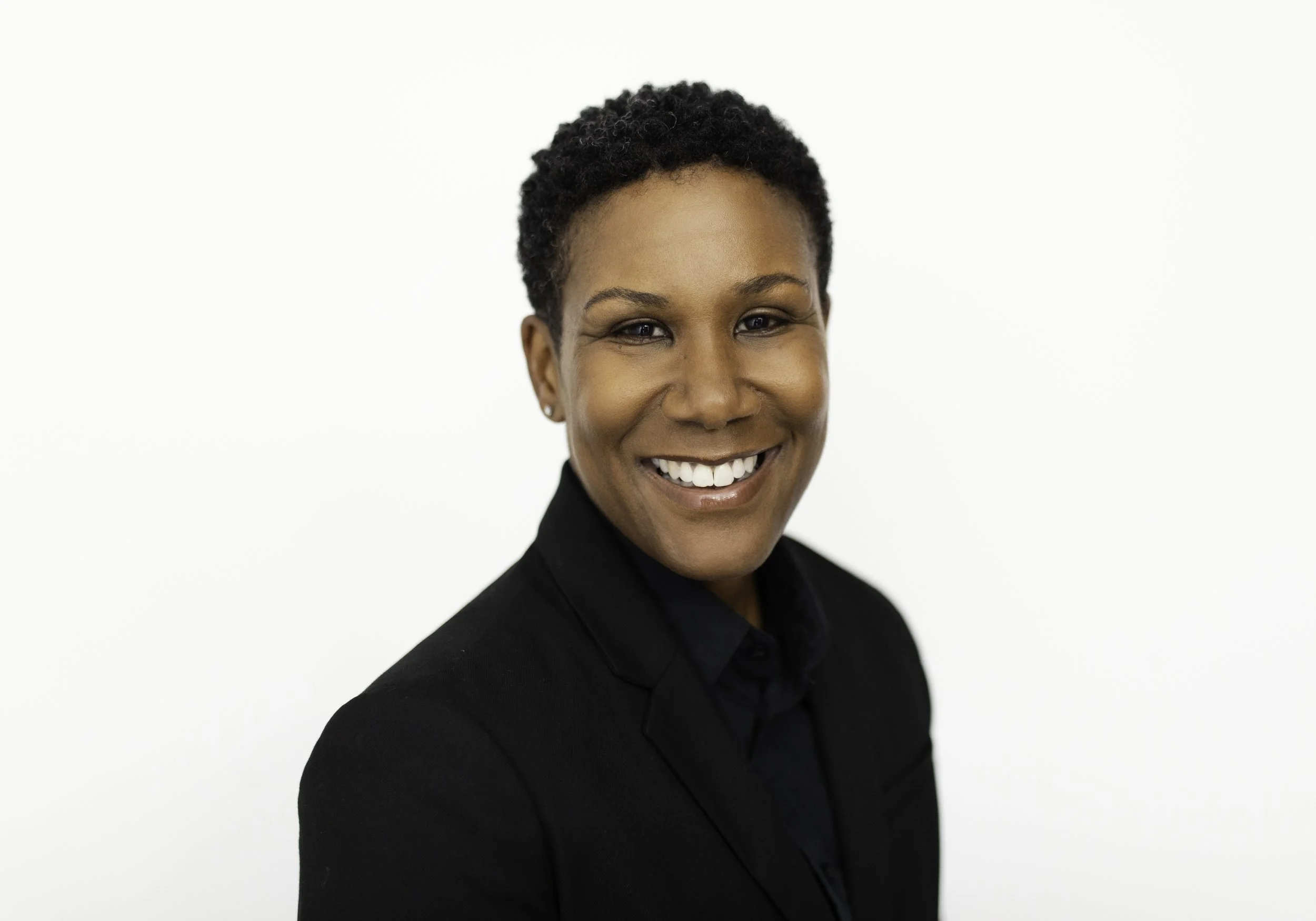
Here’s what won’t show up on her resume: Heather was a professional volleyball player in Austria, (where she had to learn German to communicate), a journalist in New York and a competitive volleyball player in college. She’s remained a lifelong athlete ever since, these days logging serious cycling miles through the
Bay Area today.

That background shows up throughout her career in how she leads: the discipline of daily training, the mental toughness to hold her composure under pressure, the instinct to read a room (or a peloton) in real time, and a deep, personal understanding of what it means to be part of a team where every rider’s position matters. In her own words: “I don’t shy away from complexity. I plan to lead with courage and remain focused on advancing the mission with both conviction and humility, building the structures and capacity Five Keys needs to grow, without ever losing what makes Five Keys so special.”

As she steps into the role of President, here’s an introduction to the person behind the title, her path, her philosophy, and what she hopes the Five Keys community will know about her.

The Prologue: Why Five Keys, Why Now

Heather’s career in education leadership, including roles with the Illinois State Board of Education and the California Department of Education, has consistently been shaped by a belief in the dignity, potential, and humanity of every person. Five Keys, she says, was a natural next move: a chance to trade the isolation of state government work for something with more immediate, human impact.

“Throughout my career in education and public service, I have been drawn to organizations that believe deeply in the dignity, potential, and humanity of every person,” says the Oakland resident. “I’ve worked adjacent to the work that Five Keys does for my entire career.  Being in public policy and state government is isolating at times, far removed from the individuals that it’s meant to impact. I was seeking a role that had a more immediate impact on individuals’ lives and I was also seeking to grow professionally. I like really challenging roles because I like
to push myself professionally. I find it really rewarding to be of service to others.”

Prior to joining Five Keys, Heather most recently served as Chief Policy and Advocacy Officer for EdVoice, a Sacramento-based education advocacy organization reshaping public education in California so that students from low-income communities have futures filled with opportunity. In that role, EdVoice and a coalition of supporting agencies helped achieve the passage of a landmark California early literacy law signed on October 9, 2025, that mandates evidence-based “science of reading” instruction, backed by a $200 million state budget investment for teacher training. She has also served as the Director of the Special Education Division for the California Department of Education, Executive Director of Special Education Services for the Illinois State Board of Education, and a Specialized Services Administrator for Chicago Public Schools.

From those roles she says she’s learned: “Leading large-scale systems requires fearless leadership, connection across sectors, relationships with key partners, and a willingness to pursue excellence in executing the vision and mission. It requires consistency, focus, regular time for reflection and feedback, course correction, and celebration. It requires content and technical expertise and supporting leaders and staff to bring a learner’s mindset and curiosity to their
work every day.”

Reading the Course

Before her years in state government and policy, Heather got her start in the classroom itself: as a special education teacher for Chicago Public Schools, and as an English and Special Education teacher for the Iowa City Community School District. That instinct for reading a room quickly, noticing what a student or family needed before they could name it, is something she’s carried into her first months at Five Keys.

“Deeply absorbing the institutional knowledge of the organization and its teams is my main priority, and establishing a shared operating rhythm built on trust,” she says. “There is so much to learn and lots of exciting work happening across the organization. I want to spend time observing, connecting, and learning.”

What’s struck her most is the sheer scope of the game Five Keys plays
across California.

“I have been incredibly struck by the sheer operational breadth and multi-layered impact of our ecosystem, from field operations like the LA Pit Stops to transitional employment and housing, schools, Home Free, and the E.A.T. Farm,” says Heather. “The absolute dedication of our teams to upholding the dignity of underserved populations at every single touchpoint is truly inspiring. Our work is about reducing barriers, and offering a compassionate first step toward long-term stabilization and career navigation.”

She’s also moved by “the sheer number of people the organization impacts every day, from a 75-year-old walking across the stage for a high school diploma, to residents obtaining permanent housing, and the level of investment Five Keys makes in our own employees.”

“This is the first organization that I have been part of that offers a variety of growth opportunities ranging from leadership to self-care. That’s a real investment and commitment to support our people to continue doing the great things they are doing on a daily basis.”
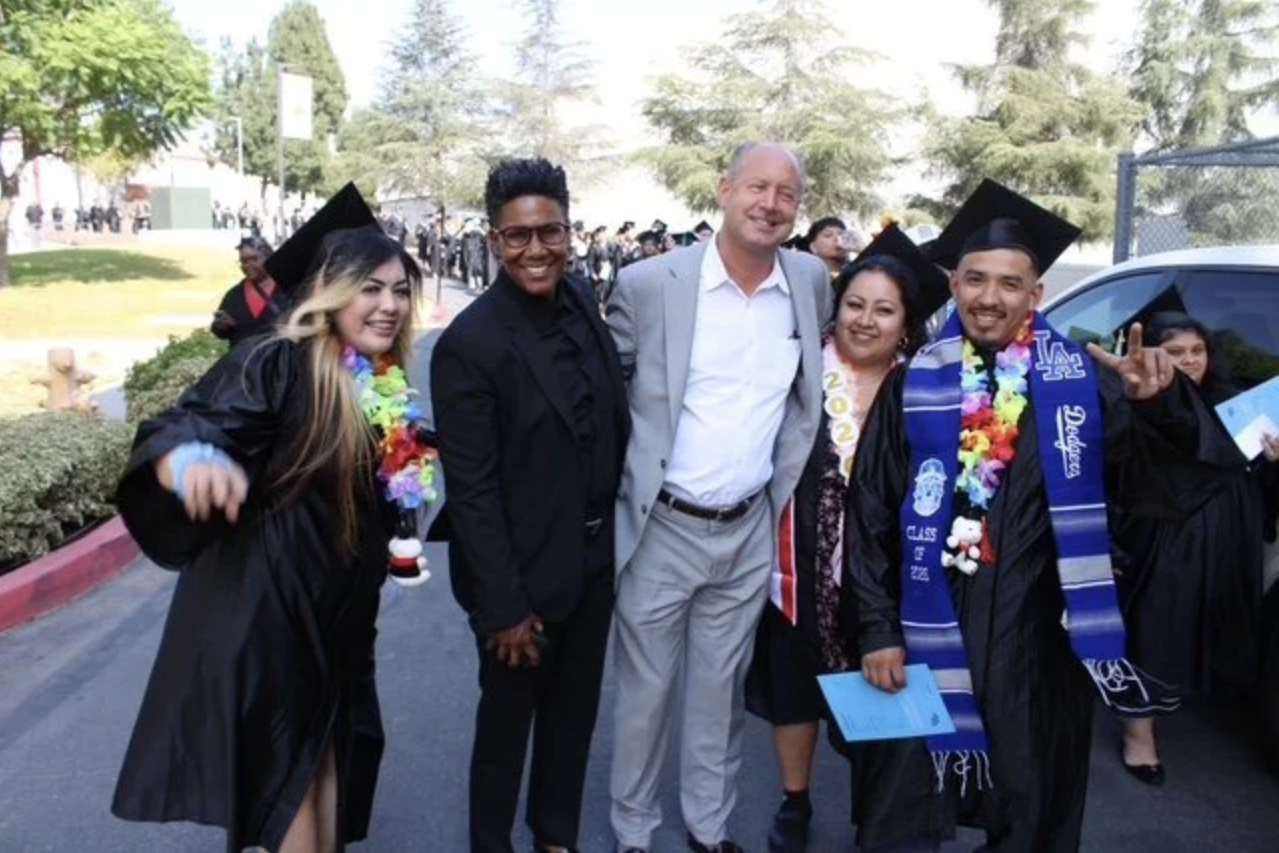
Five Keys leaders Heather Calomese and Dave Bates, VP of Engagement and Transitional Employment, celebrate with graduates at the Los Angeles graduation ceremony on June 18, 2026.

Holding the Wheel: It Takes a Community

Asked what from her special education and policy background she expects will carry into this role, she points to a few hard-won lessons.

“Relationships matter and relationships take time and should be built with intention,” says Heather. “No one individual can do this work alone, it takes a community effort, will, and skill to move the needle for real impact on the lives of people we serve. I have also learned to have pretty thick skin. Being in the roles in special education and policy that I have been in was not for the faint of heart. The work I’ve done and will continue to do at Five Keys requires facing challenges and finding solutions. Nothing is insurmountable. I’ve also learned that keeping the ‘main thing the main thing’ is important. The work that Five Keys does is about transforming lives and providing opportunities while keeping the work heart-centered and focused on improvements to the system. I’m also comfortable dealing with complexity and gray areas. This work is not black and white and
there is a lot of nuance to the work we do. Being laser-focused really matters.”


The Breakaway

Every so often, a rider attacks off the front alone — a long, grinding effort that only pays off if you’re willing to suffer for it. Heather has ridden that kind of breakaway before, leading advocacy behind California’s Golden State Teacher Grant alongside the literacy-equity work described above, work she describes as among the most demanding, and most meaningful, of her career.

“My belief that every human being deserves access to opportunities, resources, and support is what drives me every day. It’s a non-negotiable that we take care of each other,” she says. “That’s how real change happens.”
Scouting the Parcours

Heather grew up in St. Louis, MO and received her education at Concordia University Chicago — Educational Leadership and Administration, General; The University of Iowa — Master of Arts (M.A.), Special Education and Teaching, and The University of Iowa — Bachelor’s degree.

She launched her career as a reporter and editor in Iowa City and then at a small weekly paper in New York. While she enjoyed the newsroom, she didn’t see herself staying there long term. Education had always interested her, and she made the leap into special education through a program at the University of Iowa, a shift that’s shaped everything since. That early instinct for asking questions and reading a situation clearly still carries over into how she leads today: rigor, curiosity, and narrative alongside data.

“Data alone isn’t enough; we must use intentional narrative to illustrate systemic impact. Storytelling humanizes our work, shifting perspectives from cold compliance metrics to the lived reality of transformation and second chances.”

Special education became more than a career change. It became a community. Heather credits the students and families she’s served over the years with shaping who she is today, and says that drive to maximize independence for students and families, and to be of service to others, is exactly what she brings to this role.

“The students and families that I have served with over the years are always close to my heart and continue to drive my work.

These days her daily writing practice now centers on strategic vision, reflection, and staff communication. She firmly believes that data alone isn’t enough; we must use intentional narrative to illustrate systemic impact. Storytelling humanizes our work, shifting perspectives from cold compliance metrics to the lived reality of transformation and second chances.

Off the Bike

How do you like to unwind after a demanding week?

I’ve learned the hard way that self-care is non-negotiable for me. It varies,
but I usually can be found listening to music/vinyl, spending time with family and friends, spending time in nature, cycling throughout the Bay Area, at art museums (like the Museum of the African Diaspora), and relaxing at home. I like to keep things simple.

What’s your idea of perfect happiness?

Realizing my fullest potential as a human being. That means experiencing all that life has to offer. The ups and downs, the twists and turns, the joy, the not so joyful. Happiness to me is to experience the full spectrum of life and fulfill the highest version of myself.

Who’s a living person you admire, and why?

My mom (Heather’s dad passed away four years ago). She has been my biggest cheerleader and coach in life. She taught me the value of hard work, believing in myself, having a limitless mindset, and treating people well along the way. She was a computer programmer for the airlines in the 70s and 80s, which was rare for a woman, let alone a Black woman, at the time. She used to take me to work sometimes on the weekends and I would run around the computer room, where the mainframe computers were. She then transitioned to leading Human Resources departments later in her career and was always striving to be her best self and reach her potential. She is a fun person and a people person. She’s had some challenging roles in her career and I learned from her that even though the work is tough, bringing a sense of joy and optimism to the workplace is important. She has navigated so much in life and she continues to be a source of inspiration
to me today.

What do you consider your greatest achievement so far?

Leading high-impact advocacy and policy teams that successfully redirected state-level resources to high-need schools and underserved communities, ensuring that systemic equity is built into structural budgets rather than treated as an afterthought. My greatest achievement was drafting legislation, working with state legislators and other agencies to pass literacy legislation that will impact every elementary school student in California. It was a grueling and highly fulfilling achievement. That work has shown me that we have the capabilities to change systems that haven’t worked for decades and that we can collectively solve tough issues in California.

Who are your favorite writers?

James Baldwin. Zadie Smith. ZZ Packer. Toni Morrison, to name a few.

Describe yourself in six words.

Grounded. Dedicated/committed. Hard-working. Joyful. Positive. Creative.

What are you most grateful for right now?

I am profoundly grateful for the warm, open welcome I’ve received from the entire Five Keys family, and for the opportunity to navigate this meaningful organizational chapter alongside such dedicated colleagues.

What’s next on your bucket list?

Travel. Another century cycling ride (100-mile ride) and practicing my vinyl/DJ skills. I’d love to DJ! 

Five Keys Profile: Tijanna O. Eaton, Chair Board of Directors. A Life Interrupted—A New Life, Giving Back

“Three years. Twelve arrests. One shot at redemption.” That’s how Tijanna O. Eaton sums up the loss and longing she experienced during the years she spent homeless, struggling with addiction, and/or behind bars.

An honor student in high school, college attendee, and mother, she was on a trajectory for success before the world crashed around her.

But today, released and recovered from that dark period in her life, the 57-year-old Tijanna has transformed the longing and loss into determination to keep fighting for others who have lost freedoms because of addiction, poverty, racism, and other social justice inequities upheld by white supremacy that have beaten them down and thrust them onto the margins of society.

For almost a year, Tijanna has served as the Board President of Five Keys, following 16 years as a board member. She’s also recently wrapped up a successful 20-plus year career as a Senior Information Specialist in Regulatory at Genentech. In October, Tijanna finished UC Berkeley Extension's project management certificate program. 

She is grateful to be drug and alcohol free for 28 years. She believes the scars she’s accumulated on the inside have made her more compassionate on the outside. As a former recidivist, Tijanna is committed to carrying out Five Keys’ mission.

“I feel electrical impulses of empathy and impatience whenever I listen to Steve Good’s (Five Keys President and CEO) report during our board meetings,” she writes. “Empathy, because every single program we have in place, every single study packet assembled, and every single interaction with students puts them one, two, or twelve steps closer to graduating. Impatience because I want everyone to get free and educated, now!”

Since she’s been at the helm of the board, Tijanna has made it her mission to witness and support the hard work and dedication of Five Keys’ staff on the front lines of the navigation centers and schools in the San Francisco Bay Area and to explore the innovative agriculture and restoration programs in Southern California.

“I’m trying to get my arms around all the amazing programs Five Keys offers to people who need a place to come for support, and to relax, breathe, and rebuild their lives,” she says. “I want to sit down, have fireside chats, and let all the people that work for Five Keys know they have the loyalty and support the need. I’ve been those people they are serving. I know how significant and life-changing their work can be.”

A Life Interrupted

Tijanna’s nightmare began in January 1990, when she shot her first fix of heroin. Three months later, she was hooked and had developed a daily habit. Less than a year after that, she had starting mixing coke with heroin, and by January 1991 she had lost her job and would lose custody of her daughter soon afterward.

Suddenly homeless, she describes descending into full-on addiction—then becoming addicted to crack—and beginning three years of constant drug use, sleeping in alleys and doorways, using sex work to support her habit, and having frighteningly regular police contact. From April 1991 to March 1994, she was arrested 12 times and made 13 trips to jail on charges including possession of drugs and paraphernalia, prostitution, theft, trespassing, and weapons.

Starting Over

Tijanna credits the SISTER Program (Sisters in Sober Treatment Empowered in Recovery) for kick-starting her transformation. SISTERs is a collaboration between Walden House and the San Francisco Sheriff’s Department and was the country’s first in-jail treatment program, which helps women recover from drug and alcohol abuse. Arrested for the 11th time in November of 1993, she spotted a poster that asked: “Tired of going to jail? Want your kids back?” She remembers thinking: “YES!  Yes, I did.” At the time, the program hadn’t even started, and neither the deputies nor other inmates knew what it was. But Tijanna hoped it would be the bridge back to motherhood and the life that ended abruptly after her first arrest.  

She volunteered to enter the program on March 2, 1994. Two months later she was transferred to long-term in-patient treatment at Walden House, where she spent two years completing every phase of the program without relapse. Early in her recovery, Tijanna also worked for two years at SISTERs, where she provided group and individual counseling to inmates through this unique women’s recovery program. 

Upon graduation from Walden House in 1996, Tijanna began a new life. Over the next few years, she regained custody of her then eight-year-old daughter, got a job, an apartment, started a relationship, and began attending—and still attends—12-step meetings.

Tijanna says it is her hope that people who hear about Five Keys, “will feel the same way I felt and will experience the same miracle I experienced when I went to jail for the last time.”

These days, Tijanna is also at work on a memoir, BOLT Cutters, and is a proud recipient of the Unicorn Authors Club's first Alumni Award, which will help her finish her book. Her memoir chronicles the story of those twelve arrests over the course of three years during her descent into heroin addiction, jail, prostitution, and homelessness and her journey back to a brighter future.

In her book she describes how “before addiction, I had been a ‘responsible member of society,’ having graduated high school with honors, attended four years of college, become an anxious but devoted mother, and was a budding hard rock musician. I drank socially, never exceeding my two-beer limit. Until one day, I did. But how did I make the jump from simple alcoholism to homeless junkie crackhead prostitute?”
Getting clean and sober “opened my eyes to the daily onslaught of discrimination faced by Black people, women, and queers.”

She adds: “My unique experience at this intersection gives hope both to people who have been handled roughly by law enforcement as well as the people who love—or hate—them.”

Today, the words that best describe her are:  Advocate. Change maker. And tireless freedom fighter.

Five Keys Launches Custodial Maintenance Training for Formerly Incarcerated

California Prison Industry Authority offers nationally recognized certificate program that promises to get former inmates back to work 

LOS ANGELES, CA- In partnership with The California Prison Industry Authority (CALPIA), Five Keys is launching a custodian training program that will provide opportunities for formerly incarcerated men and women to join the statewide organization’s team of 300-plus custodians and get immediately back to work. Through this training, five people in Five Keys’ re-entry program will train for the next five weeks in this nationally recognized accredited certification program and are slated to begin work in September at three hotels in Redondo Beach.

2.jpg

“This is an exciting opportunity for those in our re-entry population to start a career with the State of California with permanent jobs that offer great benefits and even a retirement plan,” says Sindy Pardo, transitional coordinator for the Five Keys, who pioneered the partnership with the California Prison Industry Authority’s Custodian Certificate Training Program (CCTP) for Five Keys. The goal is to keep rolling out the program to Five Keys re-entry members in the months and years ahead.

The Five Keys training is being held at Los Angeles Mission and the Asian-American Drug Abuse Program (AADAP, Inc. - Youth & Family Programs) in Los Angeles is contributing the supplies and janitor car with brooms and mops. The hotel jobs are in partnership with 70 Million Jobs program, a database of jobs for people with criminal records.

Students in the five-week training will be trained in all the necessary job skills they need as housekeepers and building custodians including safety about cleaning chemicals, floors, and floor care equipment, maintaining floors and other surfaces, restroom care and carpeting and upholstery care.  At the completion of the courses, they will be tested for their certifications.

3.jpg


About Five Keys Schools and Programs

Dedicated to getting people’s lives back on track, Five Keys Schools and Programs currently serves 24 million people or 60% of the California population of 40 million in The San Francisco and Los Angeles areas. Five Keys was founded in 2003 by the San Francisco Sheriff’s Department as the first accredited charter high school in the nation to provide diploma programs for adults in county jails. Today its efforts have grown exponentially. The organization interrupts the cycles of homelessness, substance abuse, violence, literacy and incarceration through our 80 community learning centers, transitional housing shelters, career centers, and community-based workforce networks by investing in their humanity so that they can be self-determined to change their lives. Five Keys also hires people directly into our transitional employment positions for formerly incarcerated individuals and people currently or formerly experiencing homelessness, while also employing over 300 formerly incarcerated individuals in full-time, benefited positions. www.fivekeys.org.

About The California Prison Industry (CALPIA)

The California Prison Industry (CALPIA) is a self-supporting, customer-focused business that provides productive work assignments for approximately 7,000 incarcerated individuals within the California Department of Corrections and Rehabilitation (CDCR) institutions. CALPIA manages over 100 manufacturing, service, and consumable operations in all 35 CDCR institutions throughout California. The goods and services produced by CALPIA are sold predominately to departments of the State of California, as well as other government entities. CALPIA’s goal is to train incarcerated individuals with job skills, good work habits, and basic education and job support in the community, so when they parole, they never return to prison.www.calpia.ca.gov.

Teaching High School Classes In Maximum Security: “Gives Me Hope for the Future”

For “Miss B,” a San Jose single mother of two young adults, teaching English literature and other subjects to about 70 men in a maximum-security California jail remains the single most moving and humbling experience in her more than 21 years in education. 

“It’s so rewarding to witness students reading their own prose or smiling when they master an algebra equation, how proud they are of themselves,” says the 44-year-old former middle school language arts teacher. She adds that teaching at the jail in some ways is more rewarding than teaching in public schools.   

image2.jpeg

“Sure, there are some resistant students, but most are curious and excited to show up in class,” says Miss B. 

During the last two years, she has taught general high school courses and led a drug and alcohol program at the Santa Clara County Jail in San Jose where she says she’s learned a most important life lesson — “You are not your crime and your past does not define you.” 

“Many of the students have been convicted of violent crimes, but they still have a soul,” says Miss B. “They are still funny, smart people who have potential. I get the honor of being able to enter their home daily and form an open, respectful relationship with them. Meaning, the students are in classes to learn from me and show me respect, just as I show them respect. I also learn from them about their life experiences and have come to view things with a more empathetic lens.  I’m here to educate my students  as best I can during the time they are with me.”

In addition to teaching the core curriculum, Miss B. brings her life experience and own recovery to the jail, sharing her own story and helping inmates turn their narrative around. Miss B. knows that paying it forward also helps in her recovery as well.

As part of Five Keys Schools & Programs’ novel initiative to teach inmates at a higher level, she is passionate about the mission to turn lives around, forge opportunities and ultimately reduce recidivism and the financial and social costs to society. 

FiveKeysMissB_LaraOneHErfavorite photo.jpeg

During “normal” times, there are challenges working inside a jail,— from lack of classroom space to technological limitations — but the COVID-19 pandemic has magnified the obstacles. In order to keep on teaching these men and helping them to earn their diploma, and the possibility of a life that does not involve going back to being incarcerated, these days she drops off her lessons at the jail.  Jail staff deliver the curriculum to the inmates to complete, and then the completed work to Miss B. to review.

Miss B. jests:  “Some people asked me if I was hesitant to teach people who have murdered people. My response is that teaching middle school students, and how tough that can sometimes be, prepared me for this, and offenders are still deserving of an education.”

She says she was drawn to the opportunity to teach incarcerated students a couple of years ago when she stumbled on Five Keys during some Google research and discovered a news story clip featuring the organization.  She says she was immediately intrigued and was drawn to the mission.

“I have gained such an understanding of the odds some people face and the fact that we are all responsible for doing something to help.”

In addition to her teaching, Miss B. is also interested in training for and working with Five Keys’ restorative justice program, helping with counseling for and exploring how the programs can be brought to life at Five Keys navigation centers to help with the homeless population.

Lifting Voices Toward Hope: Five Keys Schools and Programs helps inspire hundreds of jail inmates and homeless to register and to vote

EricaIMG_1854.jpg

SAN FRANCISCO, CA, Oct.14, 2020: Dozens of newly registered voters in Alameda County and San Francisco will be able to cast their ballots in the upcoming presidential election, and many of them likely did not know they could.

Through a new “make your voice heard”- themed initiative, the leaders of Five Keys Schools and Programs are placing a high priority on making sure that the approximately 300 incarcerated students they teach in the Santa Rita Jail in Dublin, CA and the approximately 1,035 unsheltered guests who are living in the seven navigation centers and hotel sites they currently run in San Francisco and Oakland know their rights, including their right to vote. They’re helping them register and participate in the upcoming Nov. 3, election. They are also helping them drop off or mail ballots.

“It’s important for our students to know their voting rights,” says Lillian Santos-Stables, principal at the Santa Rita Jail high school education program, which is run by Five Keys Schools and Programs.  

The goal: to get the word out and enroll as many people as possible who are interested and excited to vote, adds Meg O’Neill, director of San Francisco Housing Services for Five Keys. The program is crucial, as many of the inmates and guests at the navigation and hotel shelters were not aware of their right to vote, how to access voting, where to vote and how the process works. 

Providing this information is key to removing barriers and empowering individuals to exercise their right to vote.

 “We want to make sure our guests are given agency, a voice and an opportunity to participate in this year's very important election,” O’Neill adds. “People of color, people who are poor and unhoused, people who are perceived as ‘less than,’ are often intentionally blocked from participating in the political process. Through this work, we can ensure that our guests feel welcomed and encouraged to share their voices in a political climate which threatens their rights, representation, and well-being. We hope Five Keys will lift the voices of our guests in a way that allows them to be a powerful force in the political landscape, both locally and nationally.”

At the Santa Rita Jail, Five Keys teamed up with the Alameda District Attorney’s Office to create an educational video for inmates that gives an overview of voting rights and the history of voting in the United States. Santos and teacher produced a video depicting their own “Why I Vote” stories. Principal Santos-Stables and a handful of teachers provided personal and emotional glimpses of how voting can give people a canvas for hope, unity, and justice. Their hope is to inspire inmates to keep striving for change through the power of their vote. Inmates also can meet via live video chats with teachers who can help answer their questions about history and voting.

With the Oct. 19, 2020 voter’s registration deadline looming, Five Keys leadership at the two navigation centers — Embarcadero SAFE Navigation Center and Bayshore Navigation — along with the six hotels and an eighth site, are also working to make the process of voting in the U.S. presidential election as easy and stress-free as possible for the hundreds of men and women who are currently unsheltered and have a California I.D., which makes them eligible to vote. At least one of the hotel sites worked closely with the Department of Elections to make the information accessible to guests. Many of the staff at the centers, who have transformed their own lives and have past criminal justice system involvement, were not aware until this educational campaign that they can vote on probation in California, and also were able to register.  

IMG_1882.jpg

“We kicked off efforts at all of our individual sites to get all our guests registered,” says Patricia Richard, Director of the Navigation Centers. “We want our guests to know that everybody’s vote counts and to make sure we do everything we can to help them register and vote.” 

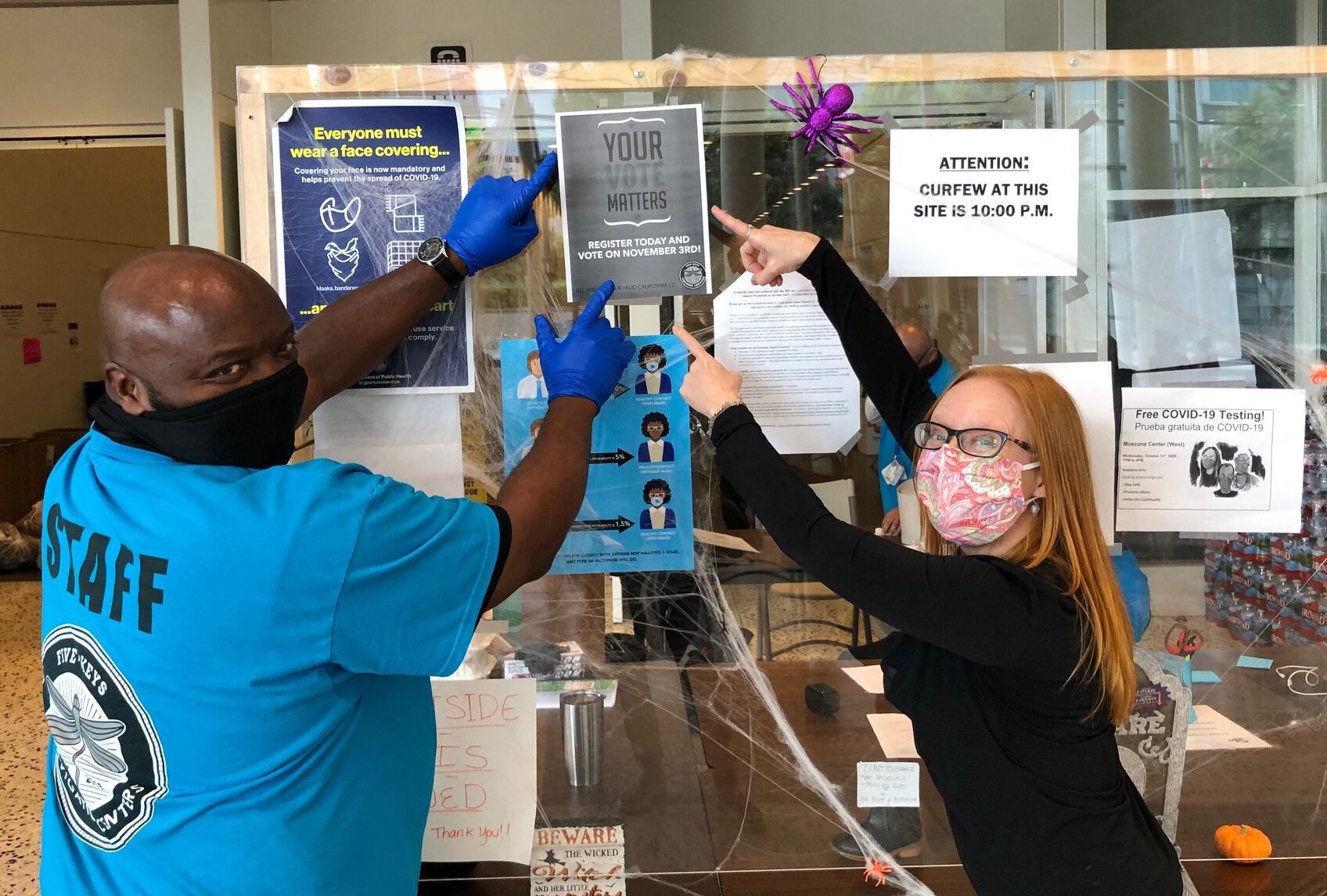
On a recent day, Raymond, who in June was released from prison when his sentence was struck down after serving 21 years of a life sentence and now is employed as an ambassador for Five Keys, was busily marching up and down the corridors of the Moscone Center posting posters proclaiming, “Your Vote Matters: Register Today and Vote on November 3rd,” and “It’s Your World. Shape it or Someone Else Will. Vote.” 

“I’m trying to do positive things to help others and save their lives,” says Raymond. 

At Santa Rita, inmates can view the video with the powerful emotional tales of Santos and the teaching staff on why it is so crucial for them to exercise their right to vote. 

“Whenever I vote, I’m honoring the legacy of my grandfather, who was one of 250,000 men from the Philippines who fought alongside Americans in World War II,” says Santos-Stables. “Because he did that, he could vote in the U.S. when he moved here. He helped pave the way for me to know I have a voice and it will be heard.”

“Not voting is not a protest, it is a surrender,” Miss F. says in the video.

Teacher Mr. Tim offered these words of wisdom: “If you have time to whine and complain about something then you have the time to do something about it.” He was quoting Anthony J. D'Angelo – American author, founder of Collegiate Empowerment and creator of The Inspiration Book Series. 

About Five Keys Schools & Programs

Dedicated to getting people’s lives back on track, Five Keys Schools and Programs and its more than 950 dedicated employees serve more than 25,000 individuals each year throughout the San Francisco Bay Area, Los Angeles and nine counties throughut the state of California. Five Keys was founded in 2003 by the San Francisco Sheriff’s Department as the first accredited charter high school in the nation to provide diploma programs for adults in county jails. Today, its efforts have grown exponentially. The organization interrupts the cycles of homelessness, substance abuse, violence, illiteracy and incarceration through our 80 community learning centers, transitional housing shelters, career centers, and community-based workforce networks by investing in their humanity so that they can be self-determined to change their lives. Five Keys also hires people directly into our transitional employment positions for formerly incarcerated individuals and people currently or formerly experiencing homelessness, while also employing over 300 formerly incarcerated individuals in full-time, benefited positions. www.fivekeys.org.

About the Santa Rita Jail

Located in Dublin, CA, the jail holds about 4,000 inmates housed in one of eighteen modern housing units. It is considered a "mega-jail" and ranks as the third largest facility in California and the fifth largest in the nation. Santa Rita is accredited by the American Correctional Association, thus making it the only facility in California holding this prestigious award. It is recognized as one of the most technologically innovative jails in the world. A robotic system speeds delivery of laundry supplies and food to all areas of the 113-acre campus. State-of-the-art criminal justice systems serve the internal operation, while the largest rooftop solar power system converts enough electricity to power nearly one-half of the facility's electrical needs during daylight hours. Sheriff Ahern's philosophy of cost-effective delivery of services is reflected in the private sector partnerships that support the jail's operation. A modem cook-chill food service operation produces 12,000 economical meals per day. On site medical and mental health services save money while reducing the patient load at county medical facilities. Throughout its history, the Santa Rita Jail Facility has served the criminal justice system and contributed to the safety of the citizens of the County of Alameda by providing a safe, secure, and humane environment for inmates and staff.

Education-Based Incarceration Program Graduates 500th Student

Education-Based Incarceration Program Graduates 500th Student At Pitchess Detention Center - KHTS News - Santa Clarita Over two dozen graduates from the Education-Based Incarceration program received their high school diplomas during a ceremony at Pitchess Detention Center Wednesday, including the 500th student to graduate since the introduction of the program in 2012.

Posted by: Michael Brown, KHTS Hometownstation.com
August 8, 2019.

Officials at Pitchess Detention Center held a graduation ceremony for students who had earned their high school diplomas through Five Keys Charter Schools as part of the Education-Based Incarceration program.

“We know it was not always easy,” said Kimberly Mendendorp, who serves as a principal for Five Keys Charter School, during the ceremony. “We are so proud of your accomplishments.”

During the ceremony, graduates had the opportunity to hear from Joshua Baker, who graduated from the Five Keys program in 2014.

“Finally finishing high school was the breakthrough I needed in my life,” Baker said.

Baker, who had been addicted to methamphetamine for 15 years, now works as a certified welder while taking classes to get his Associate’s degree in communication, as well as reconnecting with his son, who he had not seen for five years.

“You all deserve a life outside of these walls,” Baker told the graduates. “But that life will require hard work and sacrifice.

Students can earn their diplomas in a timespan ranging from a few months to three years, depending on how many high school credits they have going into the program.

“This is a great way to achieve all the goals you want out of life,” said Robert J. Olmsted, assistant sheriff with the Los Angeles County Sheriff’s Department. “This is a good basis to help get you started.” 

Over two dozen graduates from the Education-Based Incarceration program received their high school diplomas during a ceremony at Pitchess Detention Center Wednesday, including the 500th student to graduate since the introduction of the program in 2012.

Many officials echoed the sentiment of Olmsted, stating that the moment served not as an ending, but a beginning.

“It’s what you do with this diploma that is going to define the next era of your life,” said Shanley Rhodes, chief of in-custody programs in Los Angeles for Five Keys.

Many of the graduates said they were planning on seeking to further their education now that they have their high school diplomas.

“I want to further my education and go to college,” said David Enriquez, one of the 26 graduates who received their diploma Wednesday. “I don’t know what I want to take yet, but I for sure want to further my education and make this worthwhile and not just let it go to waste.”

Other graduates said they are planning to take their diplomas and start learning a trade that they can turn into a career.

“Now that I have this diploma, I’d like to further my education and go to a technical school and learn a mechanics trade,” said William Poole, a graduate who hopes to gain a career in the automotive mechanics industry.

One graduate, Oscar Lopez, got the opportunity to speak at the ceremony about how much this milestone meant not only to himself, but to his mother.

“This program has been the training wheel I needed beside my mom,” Lopez said. “Thank you for being here and helping us give my mom a present: my high school diploma.”

Lopez’s mother told those in attendance that she had stayed up until 4 a.m. because she was so excited, even clearing a space on a wall in her home for Lopez’s diploma.

“See Mom?” Lopez said. “It’s never too late for your son to improve himself.”

Read Original Post →