
Calmatters: Can Ai Help Make Homeless Californians Healthier?
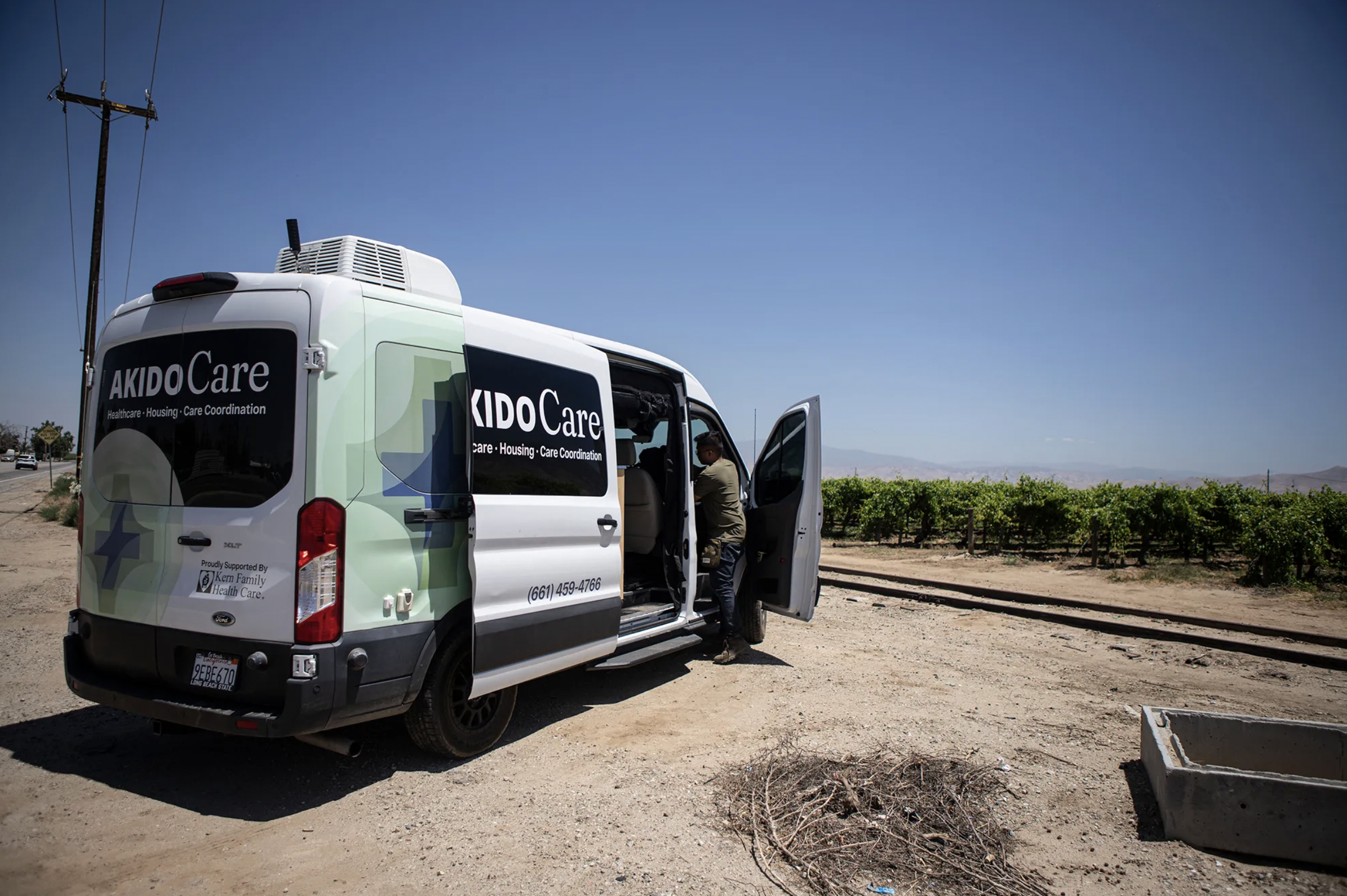
The Akido street medicine team searches for unhoused people, in order to provide medical assistance to those living in the vineyards in Arvin on May 28, 2024. Street medicine teams throughout California are increasingly using long-acting injectable antipsychotic medication to stabilize the mental health of people living in homeless encampments. Photo by Larry Valenzuela, CalMatters/CatchLight Local
By Marisa Kendall
Jan 27, 2026
Welcome to CalMatters, the only nonprofit newsroom devoted solely to covering issues that affect all Californians. Sign up for WhatMatters to receive the latest news and commentary on the most important issues in the Golden State.
As AI expands into every facet of society, a California company is testing whether the technology can help improve the health of people living on the streets.
Akido Labs, a Los Angeles-based health care technology company that runs clinics and street medicine teams in California, plans to start using its AI model on homeless and housing insecure patients in the Bay Area next month. The program generates questions for outreach workers to ask patients and then suggests diagnoses, medical tests and even medication, which a human doctor then signs off on remotely. The idea is to save doctors time and allow them to see more patients.
The new model, called Scope AI, is addressing a very real problem: There aren’t nearly enough doctors visiting encampments and shelters. At the same time, homeless Californians are in much poorer health and are dying earlier than the general population.
“There are individuals who haven’t seen doctors for years. There are individuals who haven’t seen a dentist ever,” said Steve Good, president and CEO of Five Keys, which is partnering with Akido to launch the AI technology in its San Francisco homeless shelters. “There just aren’t enough resources to go in there and find out the needs these individuals have.”
Experts who research AI told CalMatters that if done right, the technology has the power to increase access to care for homeless and other marginalized communities. But while many health care providers already are using AI for administrative duties, such as transcribing patient visits, using it to help diagnose people is still a relatively new field. It brings up concerns around data privacy, biases and patient outcomes, which are particularly pressing when the technology is being used on homeless patients and other vulnerable groups.
“We don’t have perfect solutions to a lot of these challenges yet,” said Angel Hsing-Chi Hwang, an assistant professor at USC who researches human-AI interaction.
How Scope uses AI to diagnose homeless patients
Scope AI essentially allows non-medically trained outreach workers to start the intake and diagnosis process before a patient sees a doctor.
An outreach worker goes out into the field with Scope on their tablet or laptop. As they start interviewing a patient, Scope suggests questions the outreach worker should ask. Scope listens to, records and transcribes the interview, and as the interaction progresses, it suggests new questions based on what the patient says.
When it has enough information, Scope suggests diagnoses, prescriptions and follow-up tests. That information is then sent to a human doctor, who reviews it (usually the same day) and either signs off on the prescriptions, makes changes, or, if it’s a more complex case, arranges to see the patient to get additional information. The medical care is paid for by Medi-Cal through its CalAIM expansion into social services.

Dr. Rishi Patel from the Akido street medicine team checks on an unhoused man living in a vineyard in Arvin on May 28, 2024. Street medicine teams throughout California are increasingly using long-acting injectable antipsychotic medication to stabilize the mental health of people living in homeless encampments. Photo by Larry Valenzuela, CalMatters/CatchLight Local
In demonstrating the technology to CalMatters, using an imaginary 56-year-old female patient who complained of trouble breathing, Scope asked several follow-up questions to drill down on her symptoms. Then, it made suggestions that included: a diagnosis of COPD or chronic bronchitis, a chest x-ray and spirometry breathing test, and a prescription of an albuterol inhaler.
The Scope AI technology is already being used in a few target areas. Akido’s street medicine teams began using it in homeless encampments in Los Angeles County in 2023, where it has since seen more than 5,000 patients. Akido also uses AI in encampments in Kern County, clinics in California and Rhode Island, and to treat ride-share workers in New York.